<?xml version="1.0" encoding="utf-8"?><feed xmlns="http://www.w3.org/2005/Atom" ><generator uri="https://jekyllrb.com/" version="3.10.0">Jekyll</generator><link href="https://yosubshin.github.io/feed.xml" rel="self" type="application/atom+xml" /><link href="https://yosubshin.github.io/" rel="alternate" type="text/html" /><updated>2026-08-20T03:22:55+00:00</updated><id>https://yosubshin.github.io/feed.xml</id><title type="html">Yosub Shin</title><subtitle>Field notes on robot learning, cheap hardware, and measuring things honestly</subtitle><entry><title type="html">Teaching a $300 arm to pick up a block, part 1: training</title><link href="https://yosubshin.github.io/2026/08/so101-part1-training/" rel="alternate" type="text/html" title="Teaching a $300 arm to pick up a block, part 1: training" /><published>2026-08-19T00:00:00+00:00</published><updated>2026-08-19T00:00:00+00:00</updated><id>https://yosubshin.github.io/2026/08/so101-part1-training</id><content type="html" xml:base="https://yosubshin.github.io/2026/08/so101-part1-training/"><![CDATA[<p><em>For people running robot-learning experiments on cheap hardware
(SO-101-class arms) who want to train a simple model themselves rather
than fine-tune a giant VLA. This is a journey post: the dead ends are
the content, not the final recipe. Part 1 covers getting the policy from
0% to ~43%. <a href="/2026/08/so101-part2-evaluation/">Part 2</a> covers what “~43%” even means — how we
ended up measuring the evaluation itself, down to the physics of why two
identical grasp attempts disagree 27% of the time.</em></p>

<hr />

<h2 id="0-what-we-set-out-to-do">0. What we set out to do</h2>

<ul>
  <li>One SO-101 follower + one SO-101 leader arm (teleop) + a Raspberry Pi
host + a $60 fisheye wrist camera. Task: “put the red block into the
bin.” Policy: vanilla Diffusion Policy (LeRobot port),
wrist-camera-only, trained on a single consumer GPU.</li>
  <li>Where it ended up: from 0% grasp rate to ~43% (13/30 on a 30-placement eval across left/center/right regions, with deliberately hard placements — far, close, lying-down, initially-out-of-view — mixed in), with working failure-recovery behavior, in about a week and a half— and a measured, mechanism-attributed account of the ceiling.</li>
  <li>What this post is NOT: a recipe dump. The whole recipe fits in one
sentence — enable image augmentation, restore weight EMA, train the
encoder from scratch with GroupNorm, and weight the data mix right —
the transferable part is <em>how each piece was found</em>.</li>
</ul>

<h2 id="1-pick-a-small-model-not-a-large-vla--iteration-velocity-is-the-whole-game">1. Pick a small model, not a large VLA — iteration velocity is the whole game</h2>

<ul>
  <li>Training runs are ~15–40 minutes on one GPU (RTX-6000-class; a 3090
works). The tally over ~10 days: <strong>50+ training runs</strong> (42 distinct
named experiments in the logs, plus variant families — k-shift ladders,
data-scaling probes), peaking at <strong>eight or nine trainings in a single
day</strong>; on the eval side, 10 structured grid sessions (~175 scored
placements), two DAgger sessions (~90 policy rollouts with human
takeover), and several hundred informal rollouts during debugging. The
full collect→train→eval loop turned over roughly 20 times, across 7
distinct data-collection rounds.</li>
  <li>The working rhythm: launch a training → walk to the rig → eval the
<em>previous</em> model while the next one bakes → notes → next hypothesis.
Train time ≈ eval time means the GPU and the human pipeline at 100%.</li>
  <li>Every finding in this post is downstream of that loop being fast. With a
multi-hour fine-tune, we’d have tested five hypotheses instead of fifty.</li>
</ul>

<h2 id="2-dont-blindly-trust-a-port--audit-the-training-recipe-against-the-reference">2. Don’t blindly trust a port — audit the training recipe against the reference</h2>

<ul>
  <li>Our biggest single-day gains came from <em>restoring pieces of the original Diffusion Policy training recipe that the lerobot’s DP port’s defaults had drifted away from</em>:
    <ul>
      <li>image augmentation: shipped off by default
(<code class="language-plaintext highlighter-rouge">--dataset.image_transforms.enable=false</code>); turning on the port’s
color-jitter set was worth ~8% val on our final data mix (~12% on an
earlier, smaller dataset) — and, more visibly, it flattened the
overfit curve: without augmentation the val loss bottoms out early and
climbs straight back up (see figure). Funny detail: the paper’s own
augmentation choice — random crop (Appendix A.3) — was a wash when we
added it on top. The win was having <em>any</em> appearance augmentation on,
not the specific one the paper used.</li>
      <li><strong>weight EMA: genuinely absent</strong> — the reference implementation
enables it in every config and evaluates the EMA weights; LeRobot
removed it early on (<a href="https://github.com/huggingface/lerobot/pull/134">PR #134, merged May
2024</a>) and never
restored it (<a href="https://github.com/huggingface/lerobot/issues/4259">issue
#4259</a>; an
opt-in EMA PR is open as
<a href="https://github.com/huggingface/lerobot/pull/4323">#4323</a>). For us:
+9% val at every checkpoint, and the difference between 0 and our
first repeatable successes.</li>
      <li>encoder: the port <em>defaults</em> to an ImageNet-pretrained ResNet18 with
BatchNorm (<code class="language-plaintext highlighter-rouge">use_group_norm=false</code>,
<code class="language-plaintext highlighter-rouge">pretrained_backbone_weights="ResNet18_Weights.IMAGENET1K_V1"</code>); the
paper’s main-experiment encoder — “a standard ResNet-18 (without
pretraining)” with “BatchNorm [replaced] with GroupNorm” (§3.2, used
for all main benchmark tables) — is one flag away but not the default.
Switching was −14% val at first — though §4 tells the fuller story:
most of that gap turned out to be the fine-tuning learning rate, not
pretraining itself.
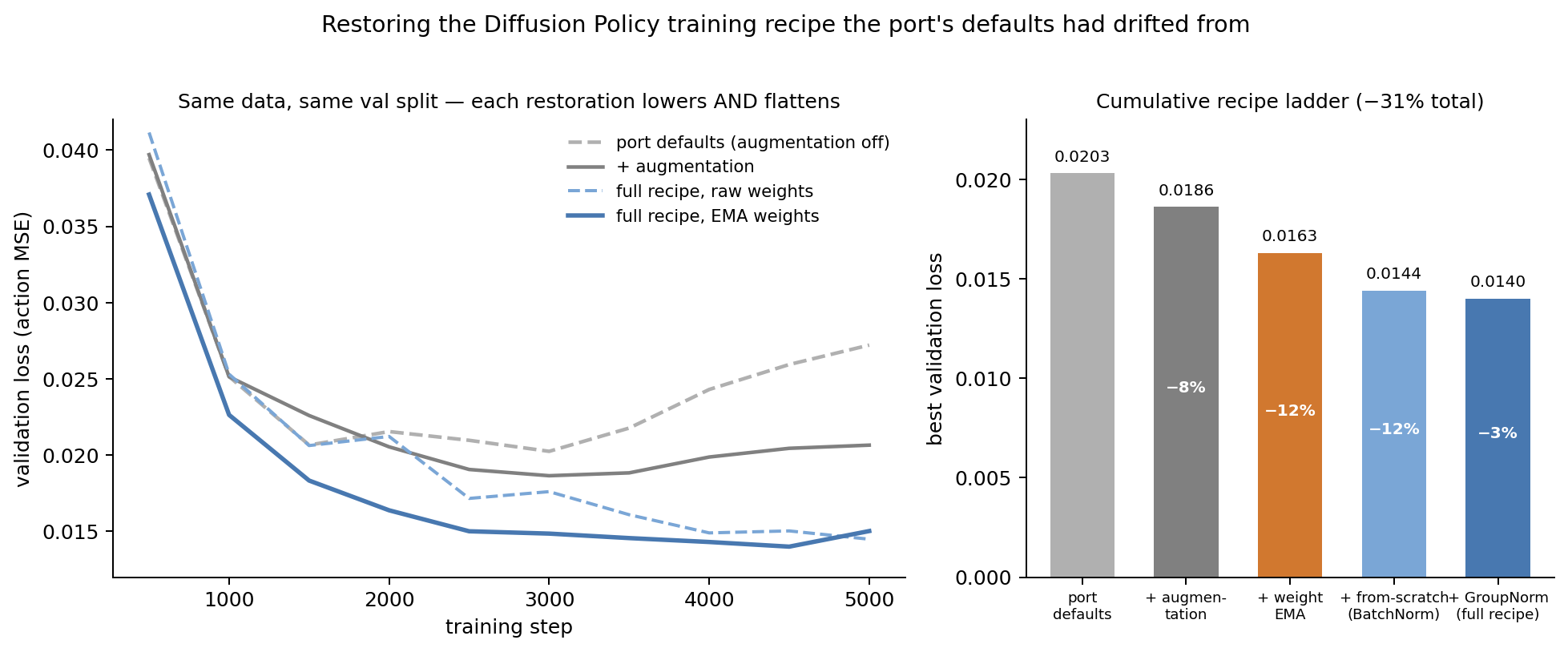
<img src="/assets/so101/recipe-ladder-val-loss.png" alt="Validation loss across recipe restorations — same data, same val split. Left: each restoration lowers the curve AND flattens the overfit tail; the true port default (augmentation off) bottoms early and climbs straight back up. Right: the cumulative best-val ladder, −31% from port defaults to full recipe." /></li>
    </ul>
  </li>
  <li>The kicker: the paper’s ONLY mention of EMA is one throwaway sentence
explaining why BatchNorm was swapped for GroupNorm. That sentence
encoded two of our three biggest wins, coupled. Read the reference
implementation’s configs, not just the paper.</li>
  <li>Lesson: ports translate <em>model definitions</em> faithfully, but training
harnesses get rewritten and defaults drift — EMA, augmentation,
encoder init are exactly what falls out. Diff the full training recipe
against the reference before trusting results.</li>
</ul>

<h2 id="3-ramp-data-gradually-collect--train--eval--repeat">3. Ramp data gradually: collect → train → eval → repeat</h2>

<ul>
  <li>We never collected more than ~100 episodes without training and
evaluating in between. Every batch’s protocol was shaped by the previous
batch’s failures:
    <ul>
      <li>gen 1 (76 eps): learned the task structure, failed the grasp →
diagnosed WHY before collecting more</li>
      <li>gen 2 (+76 teleop): modality ablation → found the real fix wasn’t
volume at all (next bullet)</li>
      <li>gen 3 (+51 corner cases + 20 staged recoveries): aimed at the
regions and behaviors that were failing</li>
    </ul>
  </li>
  <li>Our eval was a simple region-scored grid: five arbitrary placements in
each of three regions (left / center / right), scored per region. Even
that coarse structure turned “collect more data” into a targeted request
— “the left region and lying-down blocks are failing; collect those” —
which is what shaped every batch after the first.</li>
  <li><strong>The modality finding — hand-guided demos could not teach grasping.</strong>
Our first dataset was kinesthetic: you grab the arm and move it through
the task by hand, and the joint trajectory is recorded. It’s fast and
smooth, and it taught reaching and transport — but grasp success stayed
near zero, and no amount of label surgery on that data fixed it. Action
time-shifts, gripper relabeling, and segment surgery were all dead ends.
The reason is the arm’s gear backlash. When your hand moves the arm
directly, the slop in the gears never stands between your intention and
the motion — so the recorded trajectories contain no correction for it.
In teleoperation you drive a leader arm, and the follower has to move
under its own imperfect gears; you can see it lag and slip, and you
compensate without thinking. Those compensations are recorded, and they
turned out to be exactly the missing skill: with teleop data the grasp
rate jumped ~20x. If we had collected 300 kinesthetic episodes on day
one, we’d have baked in a flaw that volume cannot fix. One sentence:
<em>demonstrations must be performed through the same imperfect machine the
policy will have to control.</em></li>
  <li><strong>From corrective data to DAgger</strong> (gen 4+): with the base skill
working, the remaining failures were specific — missed grasps with no
retry, weak coverage cells. Our fixes escalated in fidelity. First,
upweighting the grasp segments of existing demos (helped as whole-episode
reweighting; destabilized as segment surgery). Next, staged recoveries:
place the block as if a grasp had just failed and demonstrate the retry —
which produced the first real recovery behavior but only covers failure
states we could imagine and stage. Finally,
<a href="https://arxiv.org/abs/1011.0686">DAgger</a>-style takeover (specifically
the human-gated variant, à la
<a href="https://arxiv.org/abs/1810.02890">HG-DAgger</a>): the leader arm
servo-tracks the follower during a live policy rollout, and pressing
SPACE flips control to the operator mid-failure — so corrections
are collected in exactly the failure states the <em>policy</em> gets itself
into, and successful rollouts get kept as free extra demonstrations. Two
rounds of that produced genuine mid-task recovery (drop the block, re-open,
re-approach, re-grasp) — imperfect, but a behavior that no amount of
ordinary demonstration data had produced. Two lessons repeated at
every rung. First, dosage: corrective episodes are few, so they need
upweighting to matter — but overweight them and the corrective behavior
leaks into normal operation (our 4x-weighted interventions taught the
policy to hover cautiously over every block, not just failed ones).
Start at 1x and raise only if the behavior doesn’t appear; we overdosed
three times before adopting that rule. Second, balance: if every
correction in a batch demonstrates the same response — ours all said
“stop twisting the wrist” — the model doesn’t learn <em>when</em> to do it, it
just does less of it everywhere, including where twisting was required.
A correction batch has to show both sides of the condition.</li>
</ul>

<h2 id="4-the-encoder-ablation--or-how-hard-you-have-to-work-to-trust-even-a-validation-loss-claim">4. The encoder ablation — or, how hard you have to work to trust even a validation-loss claim</h2>

<ul>
  <li>Swapping to the paper’s main-recipe encoder (from-scratch + GroupNorm,
per §3.2 “Visual Encoder” — the configuration behind all their main
benchmark tables) was −14% val, and the models of that era felt visibly
better on the robot. Hold that “felt” — Part 2 is about what it was
worth. This section is the story of what it took to trust even the
validation-loss half of the claim — the half you can measure from logged
data alone, without ever running the robot.</li>
  <li>We almost wrote “GroupNorm did it” — the swap necessarily changes TWO
things (you can’t put GroupNorm into pretrained BN weights). Before
letting the attribution stand, we made ourselves run the disambiguation
(BatchNorm + from-scratch, perfectly legal), and it decomposed the gain:
<strong>~12% was dropping ImageNet, ~3% (≈noise) was the normalization</strong>.</li>
  <li>Here’s where it gets interesting. Our winning configuration agrees with
the paper’s <em>main</em> recipe but seemed to contradict the paper’s own
ablation — Chi et al. §5.4 / Table 5 report that <em>fine-tuning</em> a
pretrained encoder beats from-scratch, with one crucial detail: the
backbone gets a <strong>10× lower learning rate</strong> than the rest of the
network. Our original comparison had fine-tuned at full LR. So we ran
the paper’s exact prescription (backbone at 1e-5, everything else at
1e-4, same data and val split): the gap collapsed from <strong>~14% to ~5%</strong>.
Then we asked whether even 5% was real, and reran the from-scratch
recipe with a different seed: seed-to-seed spread was ~0.5%, so the 5%
edge is about ten times the noise floor — small but genuine. The final
statement: most of the “pretraining hurts” effect was never about
pretraining — it was full-LR fine-tuning destroying the pretrained
features in the first few hundred steps — but a real ~5% residual
still favors from-scratch on this task (0.0110–0.0111 across seeds vs
0.0116). The dramatic version of the claim died on replication of the
paper’s actual protocol; the modest version survived a seed control.</li>
  <li>
    <p>The full matrix, for the record — one dataset, one val split, identical
recipe, seed noise measured at ~0.5%:</p>

    <table>
      <thead>
        <tr>
          <th>encoder</th>
          <th>norm</th>
          <th>fine-tune LR</th>
          <th>best val (EMA)</th>
        </tr>
      </thead>
      <tbody>
        <tr>
          <td>from scratch</td>
          <td>GroupNorm</td>
          <td>uniform</td>
          <td>0.0110–0.0111 (2 seeds)</td>
        </tr>
        <tr>
          <td>from scratch</td>
          <td>BatchNorm</td>
          <td>uniform</td>
          <td>0.0112</td>
        </tr>
        <tr>
          <td>ImageNet-pretrained</td>
          <td>BatchNorm</td>
          <td>backbone 10× lower (§5.4)</td>
          <td>0.0116</td>
        </tr>
        <tr>
          <td>ImageNet-pretrained</td>
          <td>BatchNorm</td>
          <td>uniform (naive)</td>
          <td>0.0126</td>
        </tr>
      </tbody>
    </table>

    <p>Decomposed with normalization held fixed: pretraining costs ~4% even
under the paper’s LR prescription; GroupNorm is worth ~1.4% over
BatchNorm from scratch; naive full-LR fine-tuning costs a further ~9%.</p>
  </li>
  <li>
    <p>Where this section lands, stated at the right level: the val ladder is
real, replicated, and decisively ordered against a measured seed floor —
and it is a result about numbers computed from recorded data, not about
behavior on the robot. We kept from-scratch + GroupNorm as the
recipe because it is val-best, simplest, cheapest (no pretrained weights
to download or protect with a special learning rate), and avoids a
BatchNorm/EMA interaction — not because we can prove it grips blocks
better. Whether any of these encoder differences survive contact with
the physical world is precisely the question Part 2 was built to answer.
A caveat that became its own investigation: when we tried to confirm
this val ladder <em>behaviorally</em>, the ranking dissolved — full-task grids
contradicted each other, a same-model repeat spanned 8/30 to 11/30, and
a purpose-built 276-trial grasp benchmark found all six encoder
configurations statistically indistinguishable at the task’s bottleneck
(while the model with the <em>worst</em> validation loss co-led it). That story — how we ended up
measuring our evaluation instead of our models — is <a href="/2026/08/so101-part2-evaluation/">Part 2</a>. The val ladder above is the defensible result; the robot
told us only that the naive fine-tune’s degradation is real and that
nothing else separates cleanly at this eval size.</p>
  </li>
  <li>Two lessons, then, not one: don’t trust the port’s defaults — and
before declaring that a paper’s ablation “doesn’t transfer to your
setup,” make sure you replicated its <em>exact</em> protocol. A single
sentence of the ablation (“10× smaller learning rate”) carried the
whole effect.</li>
  <li>The literature is consistent with where we landed: Hansen et al.
(ICML 2023, <a href="https://arxiv.org/abs/2212.05749">“On Pre-Training for Visuo-Motor Control: Revisiting a
Learning-from-Scratch Baseline”</a>)
found a learning-from-scratch baseline with augmentation competitive
with frozen large-scale pretrained representations (PVR/MVP/R3M)
across sim and real robot tasks, attributing the remaining gap to
pre-training/deployment domain mismatch — and our fisheye-wrist
single-scene setup is about as far from ImageNet’s distribution as
tabletop robotics gets. From-scratch competitive, pretraining not
harmful if fine-tuned carefully: both our result and theirs.</li>
</ul>

<h2 id="5-how-i-actually-worked-with-an-ai-assistant-on-this">5. How I actually worked with an AI assistant on this</h2>

<p>Everyone is figuring out their own AI workflow right now, so here is
what mine looked like after two weeks of daily use on a real research
project. Most of the code, scripts, and log analysis in this post was
written by the AI. Most of the decisions were not.</p>

<p>What the AI was good at:</p>

<ul>
  <li>Converting a high-level description of an algorithm into working code.
“Drive the leader arm to track the follower, and pressing SPACE hands
control to me” became a working DAgger rig the same evening.</li>
  <li>Chaining long-running operational tasks. “Build a grid over parameter
X, schedule the trainings on the remote box, score the checkpoints,
and stage the winners so I can eval” — it would run the whole chain,
including babysitting the GPU queue overnight. Evals happen in the
real world, so those stayed mine.</li>
  <li>Build and environment issues. Driver mismatches, disk-full crashes
mid-checkpoint, a servo throwing voltage errors — it debugged these
faster than I would have, and hardened the scripts afterward.</li>
  <li>Knowing the literature. When I spelled out an idea, it could usually
tell me who had done something similar and under what name (HG-DAgger,
Sirius, RT-C-style inpainting). I double-checked the citations in case
they were fake. They were mostly real.</li>
</ul>

<p>What the AI was bad at:</p>

<ul>
  <li>Watching rollout videos. It cannot spot a subtly wrong robot motion.
Every one of the breakthroughs in this post started with me watching
rollouts and saying something like “it hesitates — goes down, comes
back up, repeats” or “the left approach shakes, the right doesn’t.”
The AI could turn those one-liners into trace analysis, a mechanism,
and a next experiment by the following training run — but the noticing
was never its.</li>
  <li>Remembering what matters. Over 50 training runs, the AI would quietly
lose decisions we had already settled — and settled for a reason.
Concrete example: we ran inference at 15 Hz because at 30 Hz the
success rate dropped and you could see the arm overshooting in the
sensitive grasp region; at some point the AI reverted to an arbitrary
20 Hz with no justification. Minor, but things like this happened a
lot, and each one silently invalidates a comparison if you don’t
notice. Humans don’t forget the details they personally fought for.</li>
</ul>

<p>Practical tips:</p>

<ul>
  <li>Don’t believe the AI’s hypotheses. It produces tidy, confident,
well-argued conclusions at a rate that will lull you. Twice I
spot-checked four videos behind a data-quality audit it had built and
falsified its classifier both times. Push back as an independent
thinker; when you’re suspicious, check the raw thing yourself.</li>
  <li>Own the experiments. You need the bird’s-eye view (what question is
this week actually answering) and the low-level details (which flags,
which dataset version, which checkpoint) in your own head. The AI can
hold the middle — the execution — but if you give up either end, you
are no longer doing the science; you’re watching someone else’s.</li>
</ul>

<h2 id="6-things-that-didnt-work-kept-on-purpose">6. Things that didn’t work (kept on purpose)</h2>

<ul>
  <li>k-frame action time-shifts, to fake the command-to-motion lag missing
from kinesthetic data (hand-guided recording stores action = observed
state, so the data has no lead between command and response; shifting
actions k frames earlier simulated one). Helped, then superseded — teleop
data contains the real thing.</li>
  <li>gripper command hacks, on both sides of training. Background: the
SO-101 has no force control — grip strength comes from commanding a
position <em>past</em> the block, so the stalled servo keeps pushing. Teleop
data contains that (the operator’s trigger travels ~20 units beyond
block width); kinesthetic data cannot, because it records the <em>measured</em>
finger position, which physically stops at the block — zero squeeze
margin, every episode. So we tried rewriting the kinesthetic gripper
targets to command deeper closure. No effect: the models still failed
the grasp, because the deeper problem was the missing corrective motion
throughout the trajectory (section 3), not the closure depth label. We
also tried deploy-time overrides — snapping every gripper command to
fully-open/fully-closed, or biasing it a constant amount toward closed.
These helped our early models, which had been trained on a mix of
kinesthetic and teleop data and, fed those contradictory gripper
targets, produced averaged, indecisive closures that slipped off the
block. But once the data was fixed, the same overrides hurt: the newer
models had learned to close carefully and progressively, and the
overrides destroyed exactly those deliberate intermediate commands. A
deploy-time hack that helps is a symptom of a training-data problem —
and it turns into damage the moment the data problem is fixed.</li>
  <li>carving up episodes: oversampling grasp segments (up to a 40% share —
destroyed the approach behavior) and three escalating mid-trajectory
surgery variants on the early kinesthetic+teleop mixes, all of which
destabilized training. Reweighting whole teleop episodes did the same
job safely, every time.</li>
  <li>mixing clocks during slowed-down deployment. We run the policy at half
the training frame rate (a deliberate 2x slowdown that buys reaction
time), and the model conditions on a 2-frame observation history. The
question was how far apart those two frames should be. What we ended up
doing: one deployment tick apart (1/15 s) — at half speed, the motion
between frames then looks exactly like the motion between consecutive
training frames, so every clock slows down together. What we tried
instead: spacing the history at the training rate (1/30 s), on the
logic that “the model expects frames 1/30 s apart” — definitively
worse, because at half speed those frames show half the motion the
model saw in training, so the policy misread its own velocity. Lesson:
if you slow a policy down, slow <em>everything</em> down by the same factor.</li>
  <li>mirror augmentation: doubling the data by flipping frames horizontally
and negating the joints that move the arm laterally (base pan, wrist
roll). It helped while left-side data was scarce (left 0/5 → 3/5), hurt
once real left-side data existed, and the diagnosis turned out to be
optics: the fisheye’s optical center is not the image center, so a naive
flip shifts the whole scene laterally. Dropped in favor of just
collecting more real episodes.</li>
</ul>

<h2 id="7-fine-manipulation-on-cheap-hardware-is-legitimately-hard--and-where-that-points-next">7. Fine manipulation on cheap hardware is legitimately hard — and where that points next</h2>

<ul>
  <li>The $300 arm’s sins, all of which we hit: gear backlash that is
<em>invisible to the encoders</em> (they sit motor-side, before the gears);
plastic links that flex; screws that loosen mid-week; servos that brick
if a position command fights an obstacle (we cooked a gripper motor;
overcurrent protection + auto-reconnect became load-bearing
infrastructure).</li>
  <li>These aren’t just annoyances — they shaped the <em>science</em>: the backlash
is WHY kinesthetic demos failed (§3) and why the operator’s teleop
compensations were the missing data. On a Franka this whole story might
never have happened.</li>
  <li>Where this points next for us: a QDD-actuator arm (quasi-direct-drive —
hopefully far less backlash, torque-commandable). We actually started
this whole exploration intending to make UMI-style handheld data
collection work with the SO-101, and the project talked us out of it
three times over:
    <ol>
      <li><strong>Kinematics</strong>: UMI captures arbitrary hand orientations; the
5-DOF SO-101 has no wrist yaw, so most freely-collected
trajectories would simply be infeasible and thrown away (or
distorted by projection exactly at the contact-critical moments).</li>
      <li><strong>The kinesthetic lesson generalizes</strong>: hand-guided demos failed
because the demonstrator never experienced the arm’s backlash and
so never demonstrated the compensations (§3). A handheld UMI
gripper has the same structural flaw on the arm side — the
trajectories are collected without the robot’s gears in the loop — so we
expect the same failure mode, and would rather test that prediction
on hardware where backlash isn’t the dominant error to compensate
for in the first place.</li>
      <li><strong>Position control burns motors</strong>: a position-commanded servo that
fights an obstacle just keeps pushing — we cooked a gripper motor
exactly this way, and hard contact during grasps stayed a
failure mode all project (the policy can’t feel how hard it’s
pressing). A compliant, torque-commanded arm is inherently more
robust to both, and makes contact information available rather than
invisible.</li>
    </ol>
  </li>
</ul>

<video controls="" muted="" playsinline="" style="max-width:100%">
  <source src="/assets/so101/success-rollout-v2f-ep8.mp4" type="video/mp4" />
</video>
<p><em>A complete success rollout from the policy’s wrist camera: approach,
grasp, transport, drop into the bin.</em></p>

<ul>
  <li>Where it stands: ~43% overall success on a 30-placement eval spanning
easy to deliberately-hard cells, with recovery behavior that did not
exist in any early model. How much to trust that number — and what we
found when we tried — is <a href="/2026/08/so101-part2-evaluation/">Part 2</a>.</li>
  <li>Repo: <a href="https://github.com/YosubShin/lerobot_alohamini">github.com/YosubShin/lerobot_alohamini</a>; full experiment logs:
<a href="https://github.com/YosubShin/lerobot_alohamini/tree/main/docs/experiments">docs/experiments</a> — every claim above has a dated entry.</li>
</ul>]]></content><author><name></name></author><summary type="html"><![CDATA[For people running robot-learning experiments on cheap hardware (SO-101-class arms) who want to train a simple model themselves rather than fine-tune a giant VLA. This is a journey post: the dead ends are the content, not the final recipe. Part 1 covers getting the policy from 0% to ~43%. Part 2 covers what “~43%” even means — how we ended up measuring the evaluation itself, down to the physics of why two identical grasp attempts disagree 27% of the time.]]></summary></entry><entry><title type="html">How do you know your robot got better? Part 2: measuring the evaluation</title><link href="https://yosubshin.github.io/2026/08/so101-part2-evaluation/" rel="alternate" type="text/html" title="How do you know your robot got better? Part 2: measuring the evaluation" /><published>2026-08-19T00:00:00+00:00</published><updated>2026-08-19T00:00:00+00:00</updated><id>https://yosubshin.github.io/2026/08/so101-part2-evaluation</id><content type="html" xml:base="https://yosubshin.github.io/2026/08/so101-part2-evaluation/"><![CDATA[<p><em>Companion to <a href="/2026/08/so101-part1-training/">Part 1</a>
— training a diffusion policy on a $300 arm from 0% to ~43%. This part
is about the “~”. We set out to rank six model variants and ended up
measuring our evaluation instead — at four levels, down to the physics
of why two identical grasp attempts disagree 27% of the time. If Part 1
was about making the robot better, Part 2 is about how hard it is to
know whether you did.</em></p>

<hr />

<h2 id="0-setup-for-readers-arriving-here-first">0. Setup, for readers arriving here first</h2>

<ul>
  <li>One SO-101 follower + leader, Raspberry Pi host, $60 fisheye wrist
camera, wrist-only Diffusion Policy, task: “put the red block into the
bin.” By the end of Part 1 we had six trained variants of the final
recipe differing only in vision encoder configuration (from-scratch vs
ImageNet-pretrained, GroupNorm vs BatchNorm, fine-tuning LR), cleanly
ordered by validation loss, and we wanted to know which was actually
best on the robot.</li>
  <li>Spoiler shape: every evaluation instrument we aimed at that question
broke in an instructive way, and the instrument we finally built
answered a different — better — question.</li>
</ul>

<h2 id="1-the-noise-hierarchy-discovered-the-hard-way">1. The noise hierarchy, discovered the hard way</h2>

<ul>
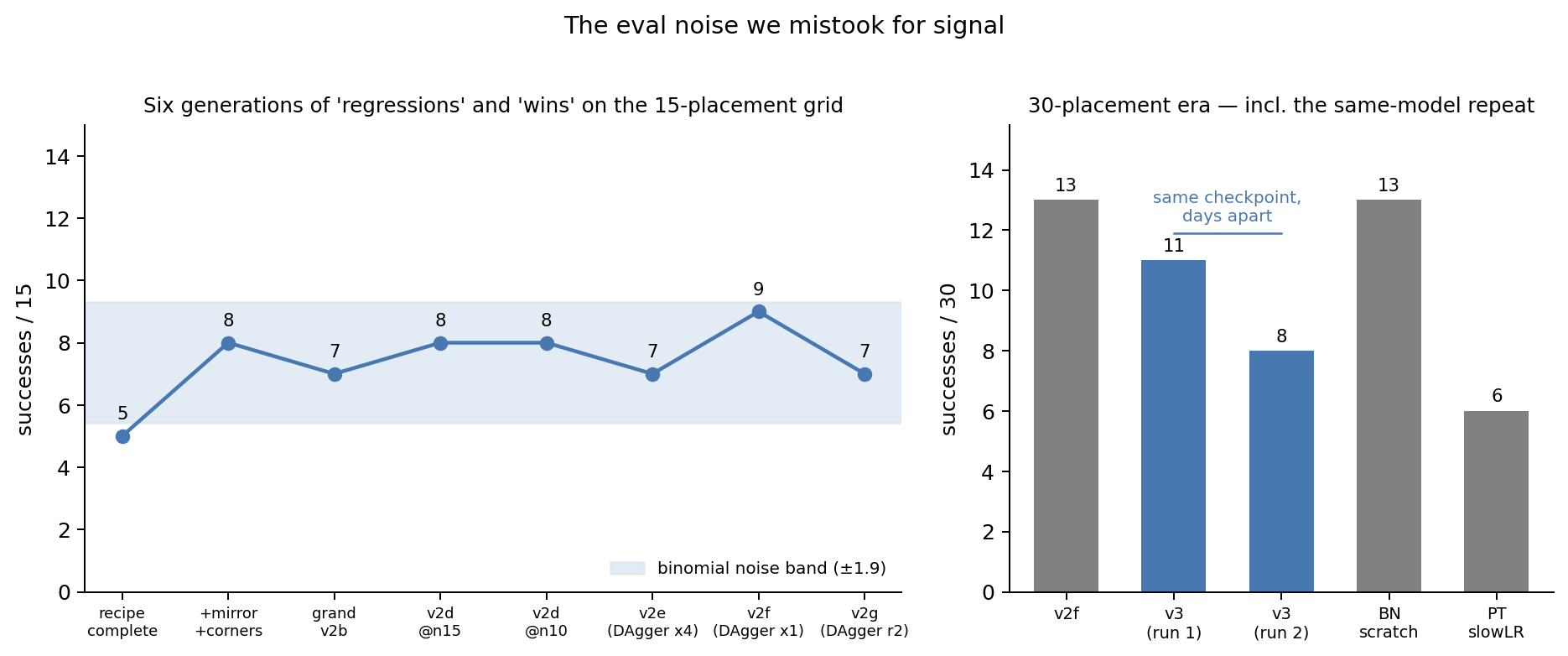
  <li><strong>Level 1: the 15-placement grid.</strong> Our workhorse eval (5 placements x
3 regions, scored by hand) oscillated 7–9/15 across six model
generations. We “diagnosed” each swing and shipped a data fix for it.
At ~50% success, the binomial noise on 15 trials is ±1.9 — we were
doing regression analysis on coin flips.</li>
</ul>

<p><img src="/assets/so101/eval-noise-hierarchy.png" alt="Left: six model generations on the 15-placement grid; every &quot;regression&quot; and &quot;win&quot; we diagnosed sits inside the shaded binomial noise band. Right: the 30-placement era, including the same checkpoint scoring 11 and 8 days apart." /></p>

<ul>
  <li><strong>Level 2: the 30-placement check.</strong> Doubling the grid deflated our
champion from 9/15 (60%) to 13/30 (43%) — the high roll regressed on
schedule.</li>
  <li><strong>Level 3: the same-model repeat.</strong> The decisive humiliation: the
<em>identical checkpoint</em>, re-evaluated on the same protocol days apart,
scored 11/30 then 8/30. Nothing changed but time and dice. Almost every
model comparison we had ever interpreted was inside this band.</li>
  <li><strong>Level 4: the rig drifts.</strong> Transport-drop failures appeared in <em>all</em>
sessions of one week and <em>none</em> of the earlier ones — across different
models. Block edges wear, gripper pads polish, screws loosen. Cross-era
comparisons carry environmental drift on top of sampling noise.</li>
  <li>Power math nobody wants to hear: resolving a 30%-vs-45% success gap at
80% power needs ~170 trials per model. By hand, at ~90 s per episode,
that is a full day per model pair. The 30-trial grid can only resolve
gaps of ≥ ~10/30.</li>
</ul>

<h2 id="2-offline-metrics--numbers-you-can-compute-without-running-the-robot--do-not-resolve-this">2. Offline metrics — numbers you can compute without running the robot — do not resolve this</h2>

<ul>
  <li>The <a href="https://abc.bot/abc.pdf">ABC report</a> — Allshire et al., 2026,
“Scalable Behavior Cloning with Open Data, Training, and Evaluation” —
shows, with Pearson/Spearman correlations across training runs (their
Figure 8), that training loss and validation <em>action error</em> — run the
full inference chain on held-out demo observations and measure the
error of the generated actions — correlate with real-world
performance, while validation loss does not (for a diffusion policy,
val loss is a noise-prediction objective, not an action comparison;
theirs even rises during training while real performance improves). We
implemented it faithfully: deploy-matched DDIM-10, fixed noise draws
shared across checkpoints, and the paper’s caveat honored (diffusion
step count held fixed, since fewer steps trivially lowers the error).</li>
  <li>Our first reading was that it failed: it ranked the model with our
<em>worst full-task grid score</em> best. But that reading used the full-task
grid as ground truth — and section 1 just spent four levels
demonstrating the full-task grid is noise. Against the grasp benchmark
(section 3), the picture partially reverses: action error’s top pick
(the low-LR fine-tuned model) <em>co-led</em> the grasp table, while
validation loss’s confident favorite finished mid-pack and its
designated worst model (the naive full-LR fine-tune) co-led. Scored
against our best behavioral instrument, action error called the winner
and val loss called it backwards — though action error also ranked
that same co-leading full-LR model dead last, so neither metric’s full
ordering survives.</li>
  <li>The honest statement of what we can and cannot conclude at our noise
floor: we cannot <em>validate</em> any offline metric’s fine-grained ordering
(the grasp-rate differences among these models are themselves within
overlapping confidence intervals). What we can say is that the two
offline metrics disagree with each other, that validation loss’s
ordering pointed the wrong way behaviorally, and that no slicing we
tried — grasp-phase-only, transport-only, single-action-dimension
(an idea independently published as Critical Interval MSE
[arXiv:2606.29898]) — changed either metric’s verdict. Offline metrics
measure reproduction of demonstrator actions on demonstration states;
the failures that matter live in states the policy creates for itself.</li>
  <li>So what are offline metrics still good for? Less than we wanted to
claim. Catching outright <em>bugs</em>, certainly — when we once evaluated
checkpoints without their normalization preprocessor, val loss read
~3.45 instead of ~0.02, an unmissable alarm. But even “gross
degradation” verdicts on real models proved unreliable: the naive
full-LR fine-tune was flagged by every offline metric in every slicing
(+14% val loss, +20% action error) — and then co-led the grasp
benchmark. On this project’s evidence, an offline gap of even that
size is a hypothesis about behavior, not a fact about it. Ranking
near-peer models is certainly not among offline metrics’ powers — in
either direction.</li>
  <li>Hygiene finding along the way: our val split had silently inherited
25% kinesthetic episodes — a modality we knew to be unlearnable for
grasping — through five generations of dataset merges. It didn’t change
rankings, but it diluted every val number we had ever reported. Check
what your val set is actually made of.</li>
</ul>

<h2 id="3-building-an-instrument-that-could-actually-measure-the-grasp-benchmark">3. Building an instrument that could actually measure: the grasp benchmark</h2>

<ul>
  <li>Diagnosis: full-task success compresses four distinct skills —
approach, grasp execution, transport, recovery — into one pass/fail
per 60–90 s episode. How those skills correlate across models is
unknown, and that’s precisely the problem: unless they happen to be
strongly aligned, a compound score can’t attribute a difference to
any of them at affordable trial counts. (The one hint we had pointed
the wrong way for compound scoring: our worst full-task model later
co-led the grasp test — within noise on both instruments, but hardly
reassurance that the skills move together.) The weakest link (the
grasp) is where outcomes are decided, so we built a unit test for it. Design elements,
each earned by a pilot failure:
    <ul>
      <li><strong>Rollout-seeded start states.</strong> A seeding policy (rotating per
scene) rolls out normally; the operator presses SPACE the moment the
block enters the gripper opening. The pose and the last two
observations are captured, and the seeding rollout continues
uninterrupted — becoming its own first trial. Start states are
guaranteed on-distribution because a policy generated them.</li>
      <li><strong>Ghost-overlay re-placement.</strong> For every subsequent trial the arm
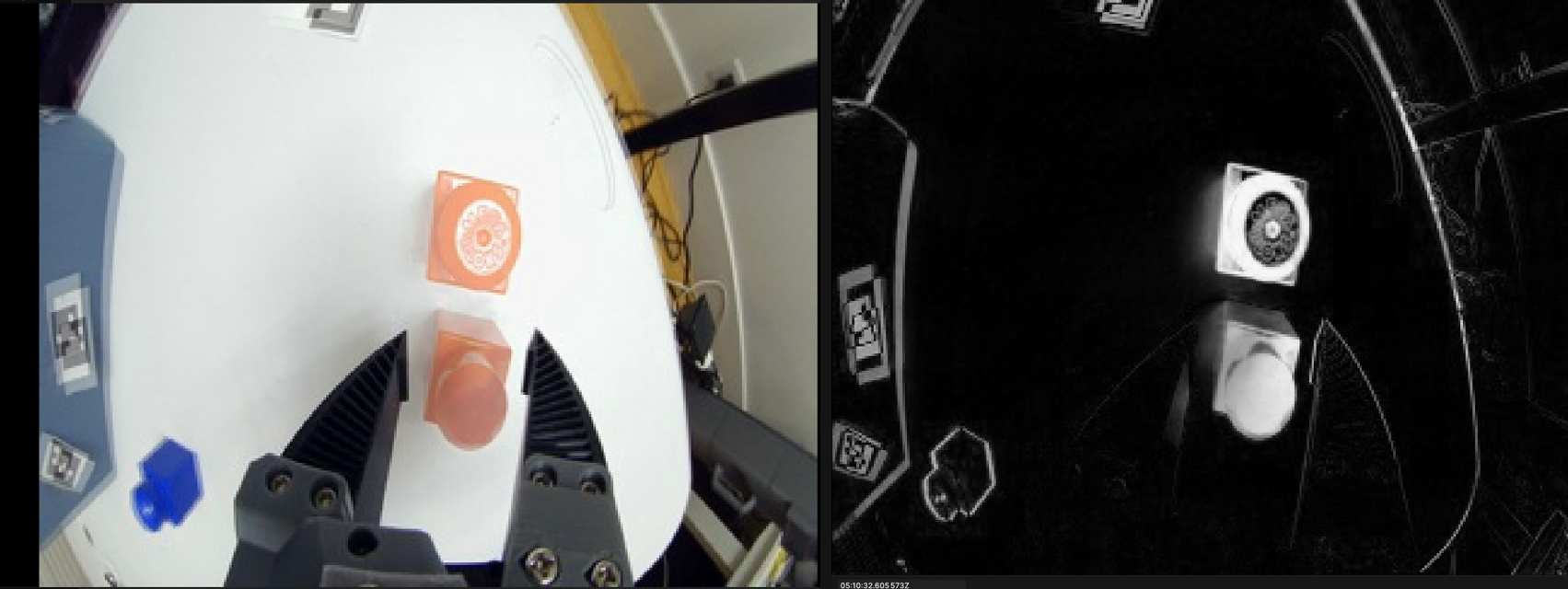
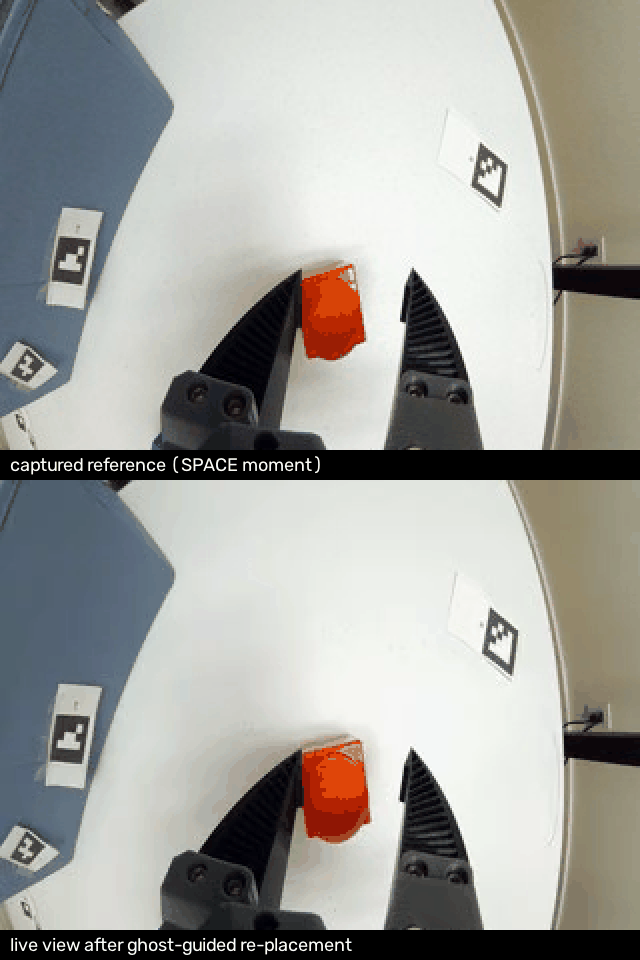
returns to the captured pose and the operator aligns the block to a
50/50 blend of live camera vs captured reference (plus a difference
view that goes dark when aligned). Pixel-accurate re-placement, no
table marks, no memory burden. Backlash means the <em>background</em> never
quite aligns — aligning the block-to-gripper relationship is the
policy-relevant thing, so that’s what the overlay optimizes.</li>
    </ul>
  </li>
</ul>

<p><img src="/assets/so101/ghost-overlay-replacement.png" alt="Left: the re-placement overlay — a 50/50 blend of the live wrist camera against the captured reference frame; the block appears ghosted in two places because it is not yet aligned. Right: the misalignment view (per-pixel difference), which glows at the two block positions and goes dark as the operator slides the block onto its reference spot. The gripper fingers cancel out of the difference because the arm is at the identical captured pose." /></p>

<p><img src="/assets/so101/ghost-overlay-aligned-flicker.gif" alt="Alternating between the captured reference and the live view after ghost-guided re-placement (same scene, real session data). The block snaps back to its reference position to within a sliver; the slight whole-scene wobble is gear backlash shifting the camera between visits to the &quot;same&quot; joint pose — which is why the operator aligns the block and ignores the background." /></p>

<ul>
  <li><strong>Matched blocks, randomized order.</strong> Every model runs on every
scene back-to-back in shuffled order, so placement variance and rig
drift are shared, not confounded.</li>
  <li><strong>A settled-grasp trigger, a scripted stress, and a human verdict.</strong>
These policies close, reopen, re-angle, and reseat, so the trial
ends on a <em>settled</em> grasp — 2.5 s of continuous closure (commanded
or measured), flicker-tolerant — not on first contact. Then a
scripted, policy-independent stress runs: lift, 4 s hold, pan
jiggle, identical for every trial, so “grip quality” becomes an
observable outcome instead of a judgment call. Scoring is a 3-level
ordinal — 0 never held, 1 acquired but lost, 2 held through the
stress — and every score was confirmed by the operator with a
keypress. We tried auto-scoring from the measured gripper width
(empty jaws close well past block width); it was not reliable
enough to trust — edge grips read as empty, so the machine’s
reading stayed a suggestion and the human stayed the judge.</li>
  <li>Calibration keys, resume, per-trial logs, and a fixed per-attempt
rubric (“one attempt = one settled closure”) — details in the repo.</li>
  <li>The experiment shape: <strong>6 checkpoints × 2 attempts per scene × 26
scenes = 280 scored trials</strong> (23 scenes fully complete across all six
checkpoints; analysis equalizes to 46 trials per model). The six
checkpoints, and why each earned its slot:</li>
</ul>

<table>
  <thead>
    <tr>
      <th>checkpoint</th>
      <th>what it isolates</th>
    </tr>
  </thead>
  <tbody>
    <tr>
      <td>GN_s1000</td>
      <td>the champion recipe (from-scratch + GroupNorm)</td>
    </tr>
    <tr>
      <td>GN_s2000</td>
      <td>same recipe, different seed — the model-seed noise floor</td>
    </tr>
    <tr>
      <td>GN_raw</td>
      <td>the same training run as GN_s1000, raw instead of EMA weights — a pure EMA ablation</td>
    </tr>
    <tr>
      <td>BN_scratch</td>
      <td>from-scratch with BatchNorm — isolates normalization</td>
    </tr>
    <tr>
      <td>PT_slowLR</td>
      <td>ImageNet-pretrained, backbone at 10× lower LR — the DP paper’s prescription</td>
    </tr>
    <tr>
      <td>PT_fullLR</td>
      <td>ImageNet-pretrained, naive full-LR fine-tune — intended as the “should lose” control</td>
    </tr>
  </tbody>
</table>

<p>Two attempts per model per scene are what make the same-state flip
rate (section 4) measurable at all.</p>
<video controls="" muted="" playsinline="" style="max-width:100%">
  <source src="/assets/so101/grasp-trial-example.mp4" type="video/mp4" />
</video>
<p><em>The policy phase of one trial from the wrist camera: handoff at the
captured state through settled grasp (6.5 s). Clips end at closure; the
scripted stress follows.</em></p>

<ul>
  <li>Throughput: ~25–35 s per trial including re-placement. 276 scored
trials across 26 scenes in a few evening sessions — the trial count
that the power math demanded and the full-task protocol could never
afford.</li>
</ul>

<h2 id="4-the-flip-floor-27">4. The flip floor: 27%</h2>

<ul>
  <li>The benchmark’s headline wasn’t a model ranking. Across 139
same-model, same-scene trial pairs — identical weights, identical
captured state, pixel-aligned block — <strong>27% of pairs flipped outcome</strong>,
almost always maximally: clean secure grasp on one attempt, complete
miss on the other. We recomputed this rate as the session grew — ~30%
after 6 scenes, 28% after 12, 27% after 26 — and it barely moved,
while over the same growing dataset the model <em>rankings</em> changed
story three times (section 5). The flip rate was the one statistic in
the whole session that behaved like a measurement.</li>
  <li>Mechanism: approach is a visual-servoing attractor that absorbs
micro-variation; the contact event is a bifurcation that amplifies it
(which fingertip corner touches first, which side of the friction cone
the block sits on — switching on sub-millimeter differences that
backlash alone guarantees); and after contact this hardware is blind —
no force, no tactile, position-commanded servos pushing open-loop.
Smooth, then chaotic, then blind. 27% is what that pipeline structure
measures out to.</li>
  <li>What follows from a 27% flip rate: on this hardware, no policy
“can grasp” or “can’t grasp” — each attempt is a draw with some
success probability, and the policy only controls what that
probability is. So comparing policies means estimating probabilities,
which takes many trials; watching a handful of attempts tells you
almost nothing. And this is where the mysteries of section 1 came
from: a 15-trial grid built on attempts that individually flip 27% of
the time <em>has</em> to swing by a couple of successes between runs. The
swings we spent weeks diagnosing were this coin flip, aggregated.</li>
  <li>The price list that follows (two-proportion test, 80% power): telling
a 60% grasper from a 40% one takes <strong>~100 trials per model</strong> — a
single evening with this harness, if you compare just two models. A
15-point gap costs ~170 per model; a 10-point gap ~390; a 5-point gap
~1,550 (required trials grow as 1/gap²). Our own session spent 46
trials per model across six models — enough to resolve only ~29-point
gaps, which is why it correctly refused to rank near-peers. Matched
scenes discount these numbers somewhat (shared hard scenes cancel
out), but the shape is the shape: on hardware with a 27% same-state
flip rate, behavioral certainty is bought in hundreds of trials, not
tens.</li>
  <li>Pre-registered prediction for the next chapter (written before the
hardware exists): on a quasi-direct-drive arm, the same-state flip
rate drops well below 27%. The mechanism decomposes into two halves,
and the QDD platform attacks both. The <em>unrepeatable state</em> half:
minimal gearing means minimal backlash (the source of the
sub-millimeter pose lottery), output-side encoders make whatever slop
remains visible instead of hidden behind motor-side readings, and
CNC-milled links don’t flex under load the way printed plastic does.
The <em>blind after contact</em> half: torque control means a wrong-footed
contact yields instead of launching the block, and motor-current
sensing gives the system a post-contact signal this arm never had.
If the flip rate on the new arm doesn’t drop, our whole mechanistic
story is wrong — that’s the point of writing the number down now.</li>
</ul>

<h2 id="5-watching-ourselves-invent-three-wrong-stories">5. Watching ourselves invent three wrong stories</h2>

<ul>
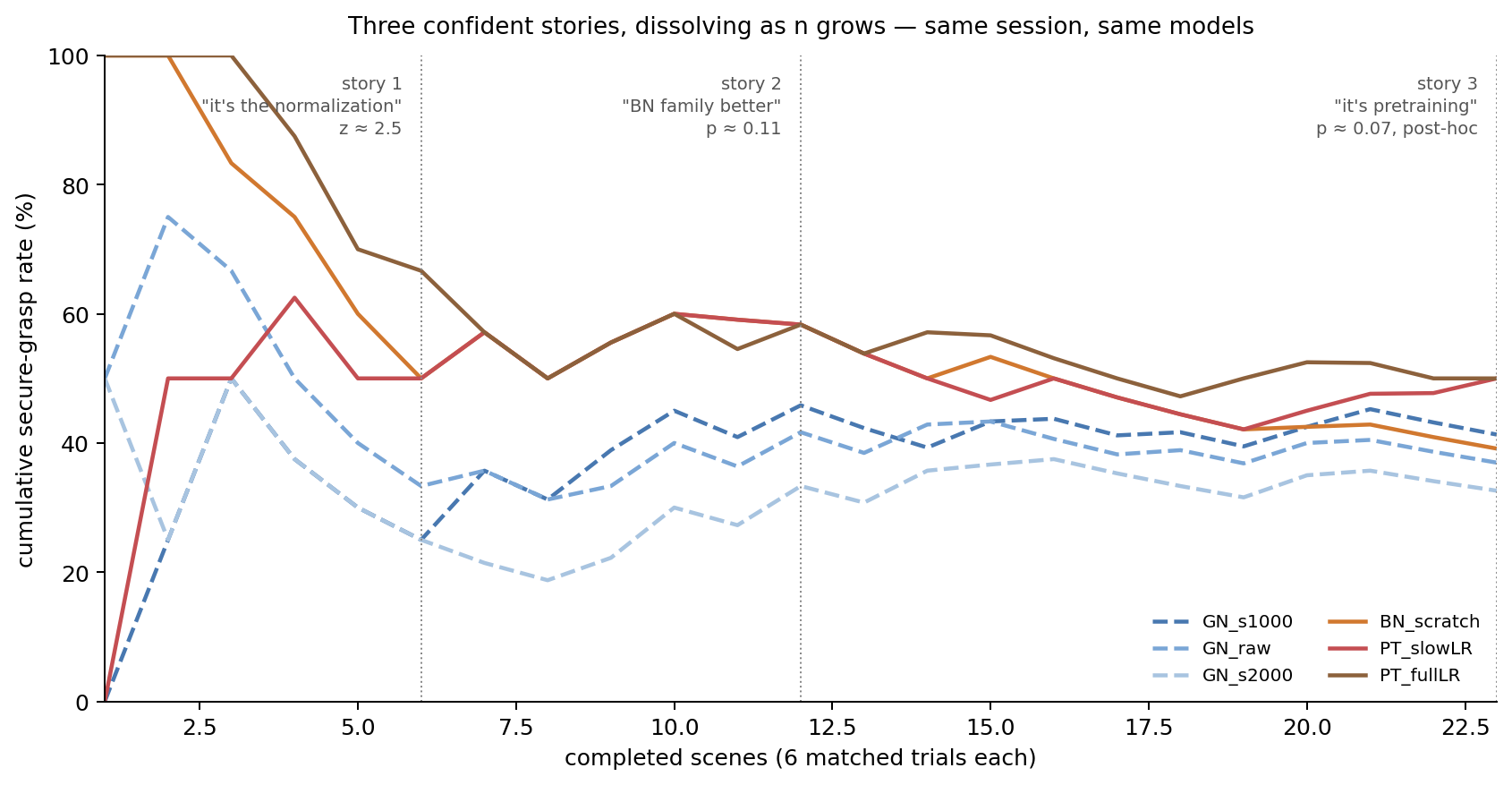
  <li>The benchmark also recorded, in time-lapse, what underpowered data does
to careful people.</li>
</ul>

<p><img src="/assets/so101/three-stories-tally-evolution.png" alt="Cumulative secure-grasp rate per model as scenes accumulate; dotted lines mark the three points at which we had a confident story, each annotated with the statistic that backed it at the time." /></p>

<ul>
  <li><strong>12 trials per model (6 scenes):</strong> all three BatchNorm variants
above all three GroupNorm variants, pooled 57% vs 28%, z≈2.5. We drafted a normalization
mechanism (EMA/BatchNorm-buffer interaction) with literature support.</li>
  <li><strong>24 trials per model (12 scenes):</strong> the BN-family gap softened to p≈0.11 but “held
direction.” The story survived, upgraded with a phase-decomposition
narrative.</li>
  <li><strong>46 trials per model (23 scenes):</strong> the family gap dissolved (p≈0.48; the first-half gap
of +0.40 score points went to −0.05 in the second half), one model
collapsed from 58% to 39%, and a <em>different</em> post-hoc grouping
(pretrained vs from-scratch) now sat at p≈0.07. Story number three,
adopted after seeing the data, one comparison among dozens examined.</li>
  <li>The three stories’ fates differ in kind, and it matters: stories one
and two were <em>falsified</em> — more data from the same session killed
them. Story three was never tested. An uncorrected p≈0.07 on a
grouping chosen after looking at the data is exactly the shape of
evidence that had already fooled us twice, so we ended the session
declining to believe it rather than disproving it. If
pretrained-vs-from-scratch grasp quality ever matters, it costs one
fresh, pre-registered, two-model session (~100 trials each, per the
price list above); until someone pays that, it is a hypothesis, not a
finding.</li>
  <li>Every safeguard was in place — matched blocks, randomized order,
pre-registered read-order, a positive control — and the stories formed
anyway, because grouping-choice happens between the safeguards. Each
story came with a plausible mechanism, and the mechanisms’ eloquence
was uncorrelated with their truth (the AI assistant generated them
fluently; see Part 1’s section on working with AI).</li>
  <li>What actually protected us, in the end: pre-committed read-order, a
positive control whose misbehavior we eventually heeded, seed-pair
entries (the seed pair, the raw/EMA pair) measuring the noise floor
<em>inside</em> the experiment, and letting the trial count grow past the
point where the story was exciting.</li>
</ul>

<h2 id="6-what-survived-and-the-protocol-wed-start-with-next-time">6. What survived, and the protocol we’d start with next time</h2>

<ul>
  <li>Findings that held at full rigor:
    <ol>
      <li>The 27% same-state flip floor — the best-measured number the
project produced.</li>
      <li>EMA: +9% validation loss, at every checkpoint, in the cleanest
possible ablation (same run, two weight views) — and <em>zero</em>
detectable grasp-behavior effect at 46 trials per model. Restore it (it’s
free), but don’t expect it to rescue behavior.</li>
      <li>No encoder configuration separates at the grasp (33–50%, all CIs
overlapping) — while validation loss orders the same six models
decisively. Echoes the Diffusion Policy paper’s own fine print:
“the best performance across different architectures is not large.”</li>
      <li>Underpowered evals generate confident, evolving, wrong stories —
three of them, in one session, from us, with the receipts logged.</li>
    </ol>
  </li>
  <li>The protocol we’d adopt from day one on the next platform:
    <ul>
      <li>Same-model repeats <em>first</em> — measure the flip floor before comparing
anything.</li>
      <li>Matched blocks with randomized within-block order; never compare
across sessions without a bridge arm.</li>
      <li>Positive control in every session; if it misbehaves, suspect the
instrument and the rig before inventing science.</li>
      <li>Unit-test the bottleneck phase (grasp) at high n instead of
full-task at low n; keep full-task runs for existence proofs
(recovery works; scanning appeared), which are immune to this whole
essay.</li>
      <li>Pre-register groupings; anything discovered post-hoc buys a
hypothesis, not a finding, and pays for its own fresh session.</li>
    </ul>
  </li>
  <li>Where this leaves the headline number: Part 1’s “~43%” is honest
precisely because the “~” is now a measured object — ±3/30 sampling, a
27% per-contact flip floor, and a rig that drifts by the week.</li>
  <li>Repo: <a href="https://github.com/YosubShin/lerobot_alohamini">github.com/YosubShin/lerobot_alohamini</a>; harness:
<a href="https://github.com/YosubShin/lerobot_alohamini/blob/main/examples/alohamini/grasp_eval_so101.py">grasp_eval_so101.py</a>;
experiment logs: <a href="https://github.com/YosubShin/lerobot_alohamini/tree/main/docs/experiments">docs/experiments</a> — every number above has a
dated entry.</li>
</ul>]]></content><author><name></name></author><summary type="html"><![CDATA[Companion to Part 1 — training a diffusion policy on a $300 arm from 0% to ~43%. This part is about the “~”. We set out to rank six model variants and ended up measuring our evaluation instead — at four levels, down to the physics of why two identical grasp attempts disagree 27% of the time. If Part 1 was about making the robot better, Part 2 is about how hard it is to know whether you did.]]></summary></entry></feed>